Projects
| Scalable Graph Neural Networks for Ultra-Scale Heterogeneous Networks: Methods and Applications Graph neural networks (GNNs) have emerged as a fundamental model for processing complex graph-structured data. However, when applied to real-world networks characterized by ultra-large scale, semantic heterogeneity, and dynamic evolution, existing models face critical challenges, including neighbor explosion, prohibitive computational and memory costs associated with full-graph training, and the difficulty of tracking long-term temporal evolution. To address these issues, this proposal focuses on ultra-large-scale heterogeneous temporal networks and aims to develop highly scalable GNNs that synergistically integrate structure, semantics, and temporal dynamics, along with their applications. The core research encompasses the following: First, we will investigate highly scalable graph neural networks tailored for ultra-large-scale heterogeneous graphs, designing various effective mechanisms to decouple the complex dependencies inherent in full-graph message passing, thereby enabling efficient and unbiased training and inference on big graphs. Second, for ultra-large-scale dynamic heterogeneous temporal graphs, we will construct an evolution tracking mechanism based on micro-topological transitions and a time-aware state space model, systematically enhancing the efficiency and scalability of dynamic big graph learning. Finally, we will build a recommendation system based on these ultra-large-scale heterogeneous graph neural networks, applying the proposed theoretical framework to scenarios such as sequential recommendation and multi-behavior recommendation, achieving a cohesive integration of global semantics and local evolution. The outcomes of this proposal are expected to fundamentally break through the scalability bottlenecks in complex ultra-large-scale graph learning, advancing graph neural networks from a trainable paradigm to an industry-deployable solution, thereby providing robust technical support for core business operations in China's digital economy. | 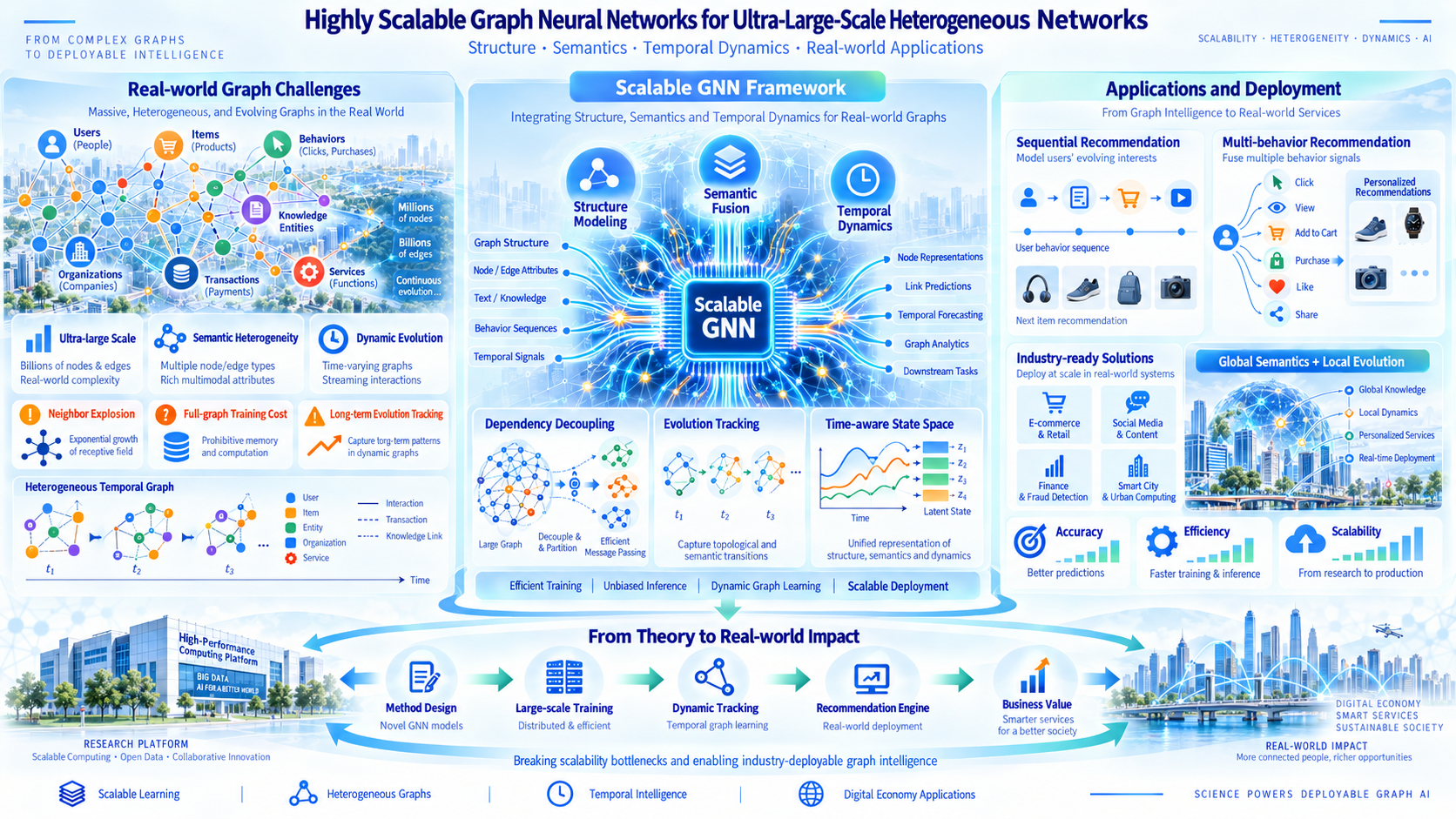 |
| Development of an AI-Assisted System for Metabolic Subtype Identification and Personalized Nutritional Intervention Strategy Formulation This project aims to address the challenges of complex metabolic states, substantial individual variability in nutritional requirements, and experience-dependent nutritional decision-making in critically ill patients with severe infections. An artificial intelligence-based personalized nutritional therapy system will be developed. By integrating multimodal clinical data, the project will establish a unified data representation and analytical framework to achieve accurate metabolic state identification and nutritional risk assessment. Furthermore, by combining medical knowledge with intelligent decision-making models, the project will develop personalized nutritional strategy generation approaches to optimize the timing and formulation of nutritional interventions. Through multicenter clinical feedback and continuous model refinement, the proposed system will facilitate the application of intelligent nutritional decision support in critical care medicine. | 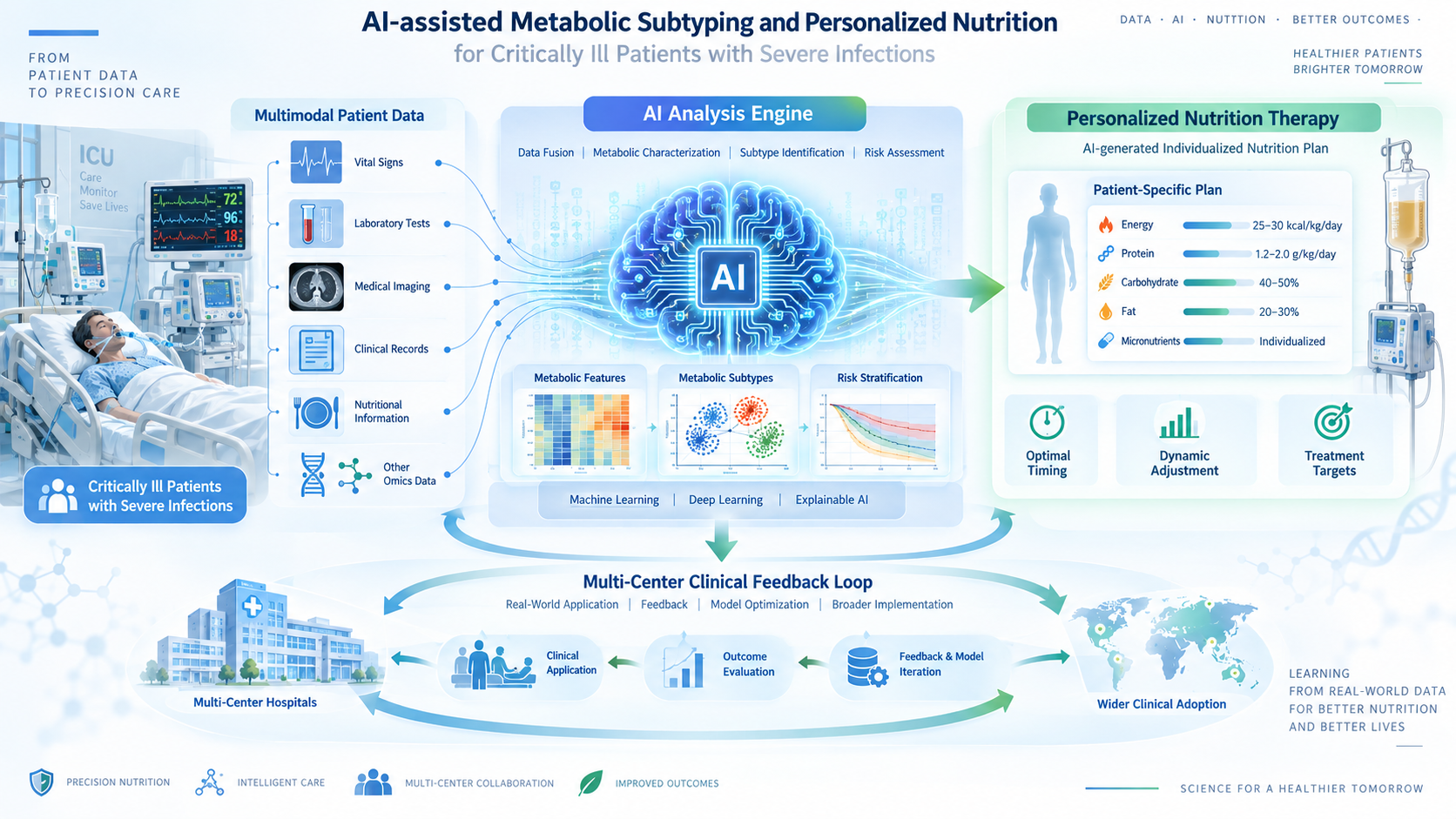 |
| Modeling, Forecasting and Policy Evaluation for Intelligent Transportation This project aims to develop an intelligent traffic analytics framework through three integrated components: (1) mining spatiotemporal patterns of congestion propagation in road networks using big data to identify critical influencing factors and inter-road correlations; (2) constructing a graph neural network-based prediction system with multi-source data fusion for real-time traffic forecasting; (3) establishing a policy evaluation mechanism that assesses public transport performance across accessibility, reliability, and equity dimensions while quantifying policy impacts on congestion mitigation and efficiency improvement. The research will generate both predictive tools for traffic management and evidence-based policy recommendations for sustainable urban mobility. | 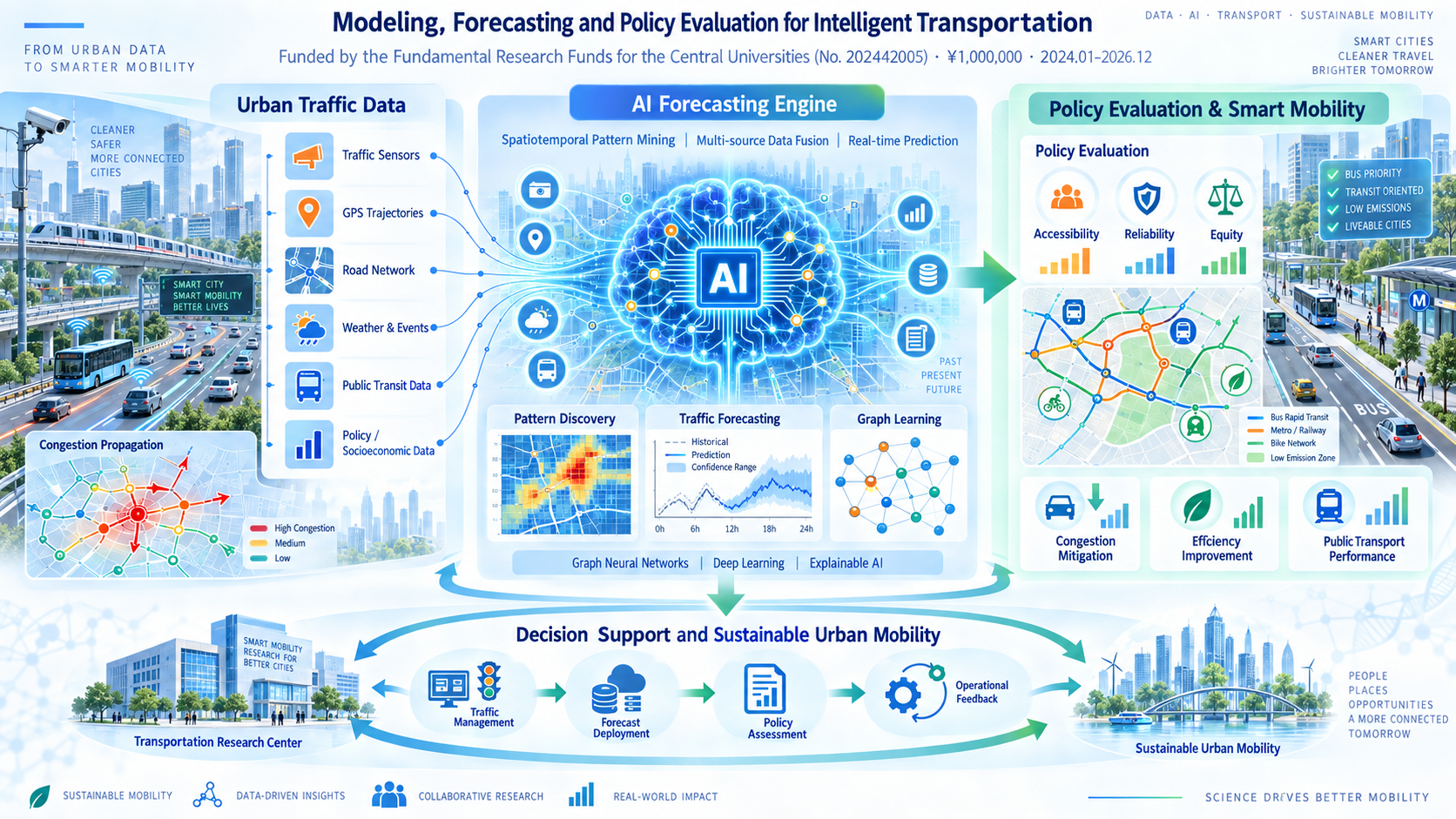 |
| Large-scale Pre-trained Model for Spatiotemporal Representation Learning This project initiative aims to develop an innovative pre-trained spatiotemporal representation learning model to address three critical applications of spatiotemporal data mining: (1) traffic flow prediction in intelligent transportation systems, (2) location recommendation in location-based social networks (LBSN), and (3) hydrological forecasting in marine science. The project will focus on establishing an effective deep learning framework based on large-scale pre-trained models for spatiotemporal representation learning, while systematically investigating and validating the model's effectiveness across these diverse application domains. | 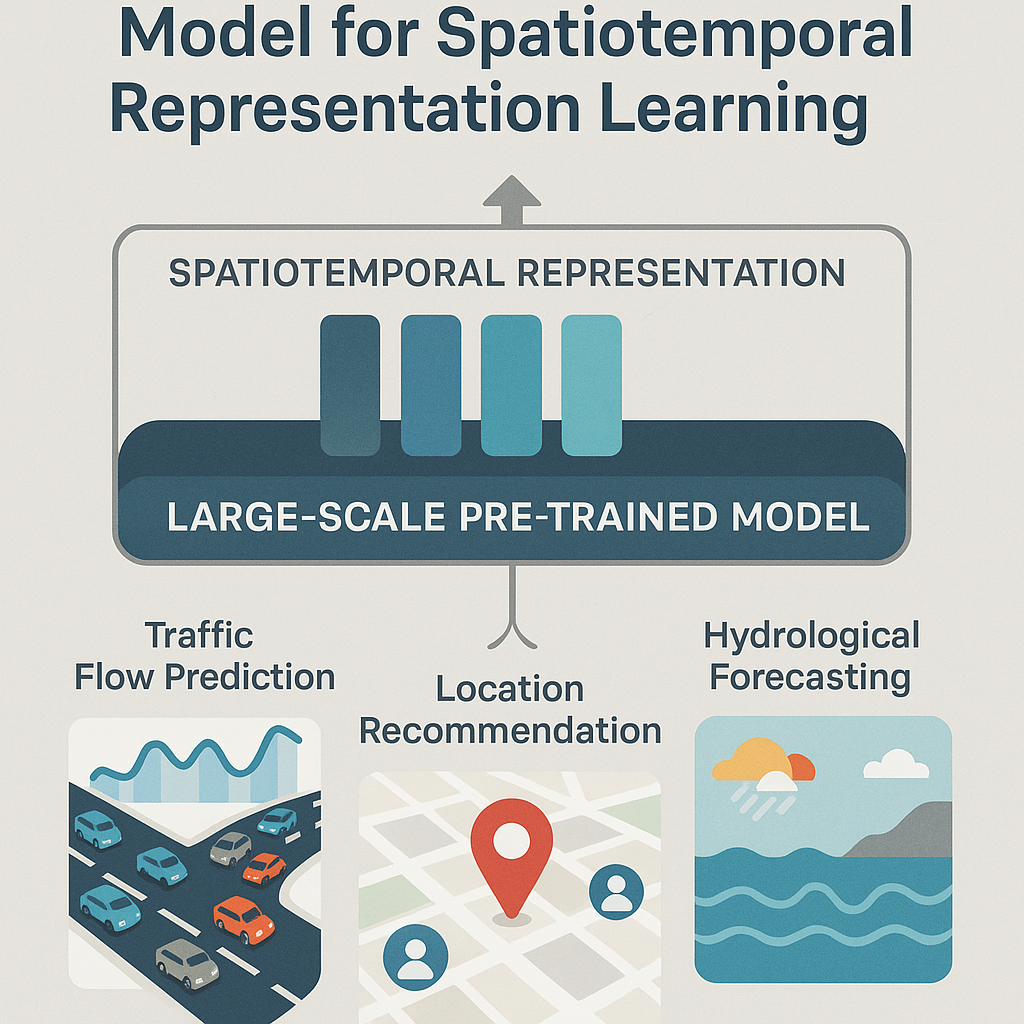 |
| Representation Learning for Large-Scale Complex Spatiotemporal Data and Its Applications This project plans to conduct an in-depth study on representation learning for large-scale spatiotemporal data and its applications. First, we will build an effective representation learning framework with the exploration of spatiotemporal data from different dimensions. Then, we target at five different real-world applications for our evaluation of spatial-temporal representation learning frameworks, i.e., trajectory-user linking, trajectory prediction, location recommendation, relationship inference, and trajectory anomaly detection. Specifically, we will design customized deep learning models for these applications within their unique spatial-temporal context. | 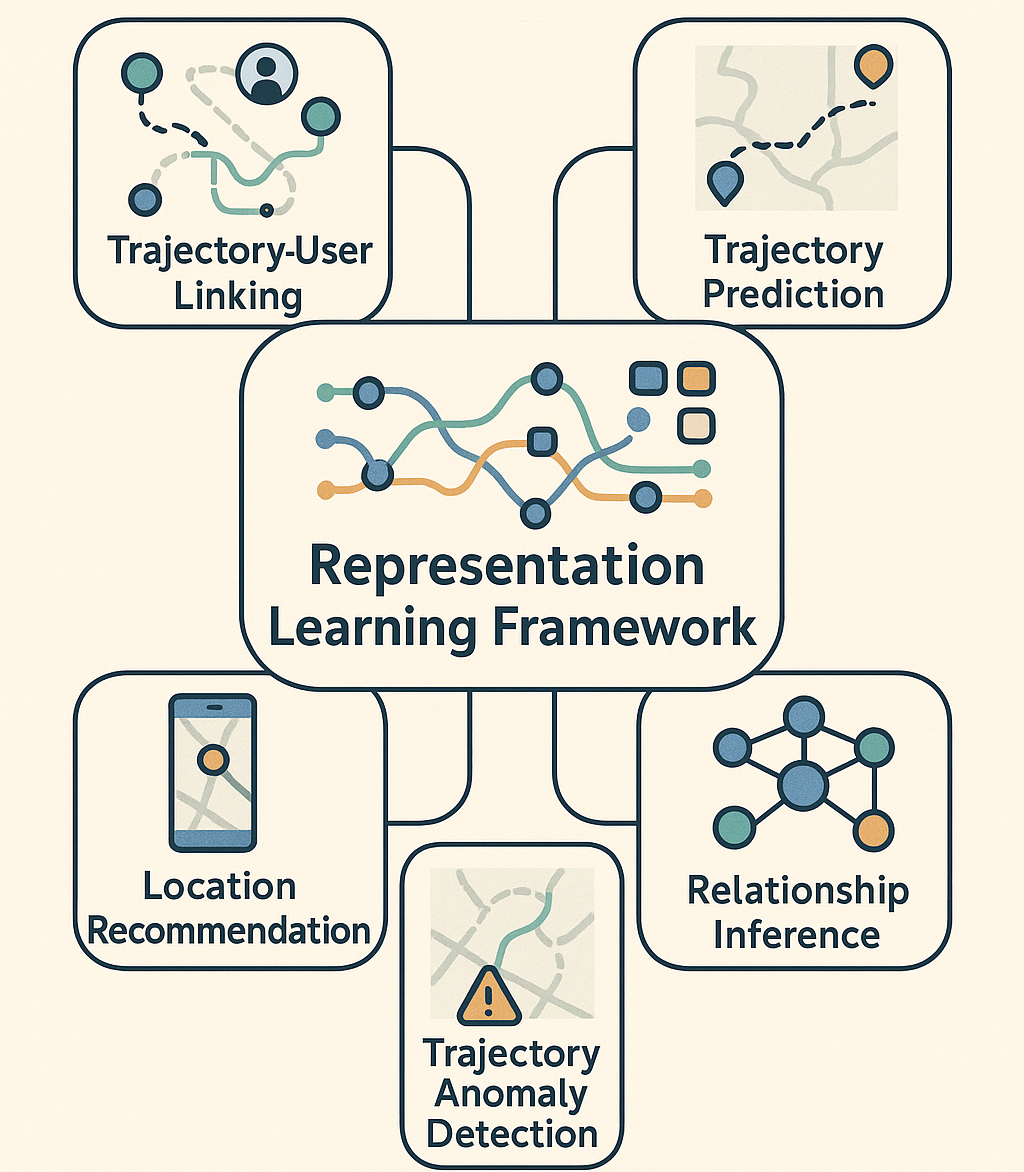 |
| Semantic Annotation and Semantic Pattern Mining for Trajectory Big Data This project selects spatiotemporal trajectory big data as the research object, and conducts in-depth research on the semantic-integrated trajectory data pattern mining and anomaly detection technologies. For mobility relationship inference integrating semantic features, this project proposes a friend relationship inference model based on graph embedding, which introduces semantics such as POI categories into meeting events, effectively improving the inference performance of friend relationship. For important location inference based on traffic big data, this project proposes an accurate home location and work area inference method, which realizes the annotation of important locations on sparse vehicle trajectories. For traffic inference based on traffic big data, this project completed a series of studies on citywide traffic volume inference, from spatiotemporal semi-supervised model to traffic simulator model, and to spatiotemporal representation learning model, achieving the state-of-the-art performance. For high-efficiency anomaly detection, this project proposes a fast Top-n local anomaly detection algorithm. Aiming at the problem of local anomaly detection in streaming big data environment, a Top-n local outlier detection method based on kernel density estimation is designed, which realizes efficient and effective Top-n local outlier detection in streaming big data. For the anomaly detection of high-dimensional data, this project proposes a layer-constrained variational auto-encoding kernel density estimation model and an autoregressive flow-based anomaly detection model. | 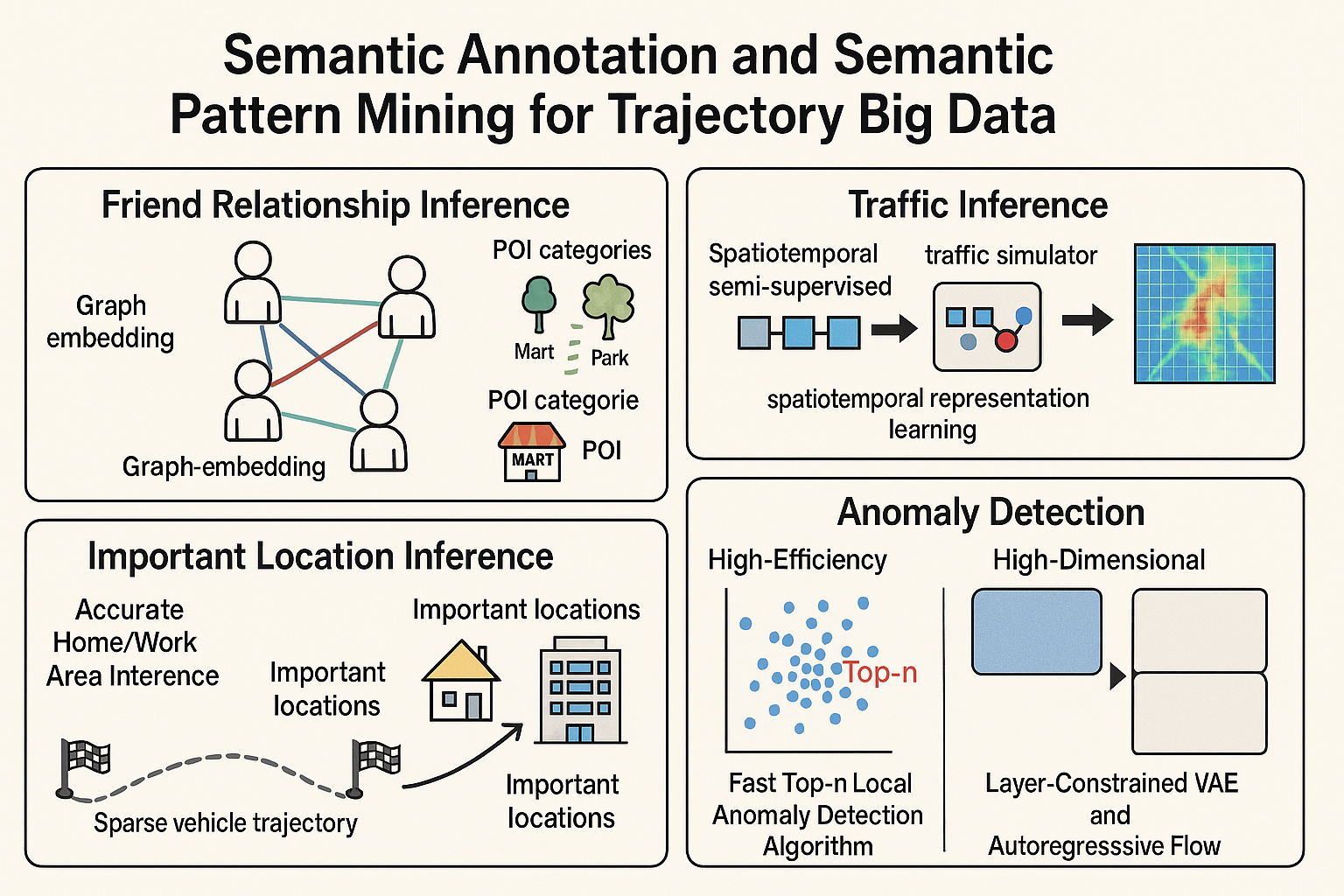 |
| Distributed Anomalous Event Detection over Big Spatio-Temporal Data Streams This project has carried on the thorough research of distributed outlier detection and trajectory pattern mining for spatiotemporal trajectory big data. First, we proposed a class of novel neighbor-based trajectory stream outlier model, which takes the different semantics of spatiotemporal neighbors and effectively captures various anomalous events in different scenarios. Second, we completed a series of efficient clustering algorithms and density-based clustering for streaming big data, and implemented the evolving clustering analysis in spatiotemporal data streams. Third, we designed a load-balanced data partition method in distributed stream processing system for spatiotemporal big data. Finally, we also completed the mining of trajectory group patterns based on cluttering for high-volume trajectory streams, and further realized the parallel algorithm design for distributed spatiotemporal trajectory pattern mining. | 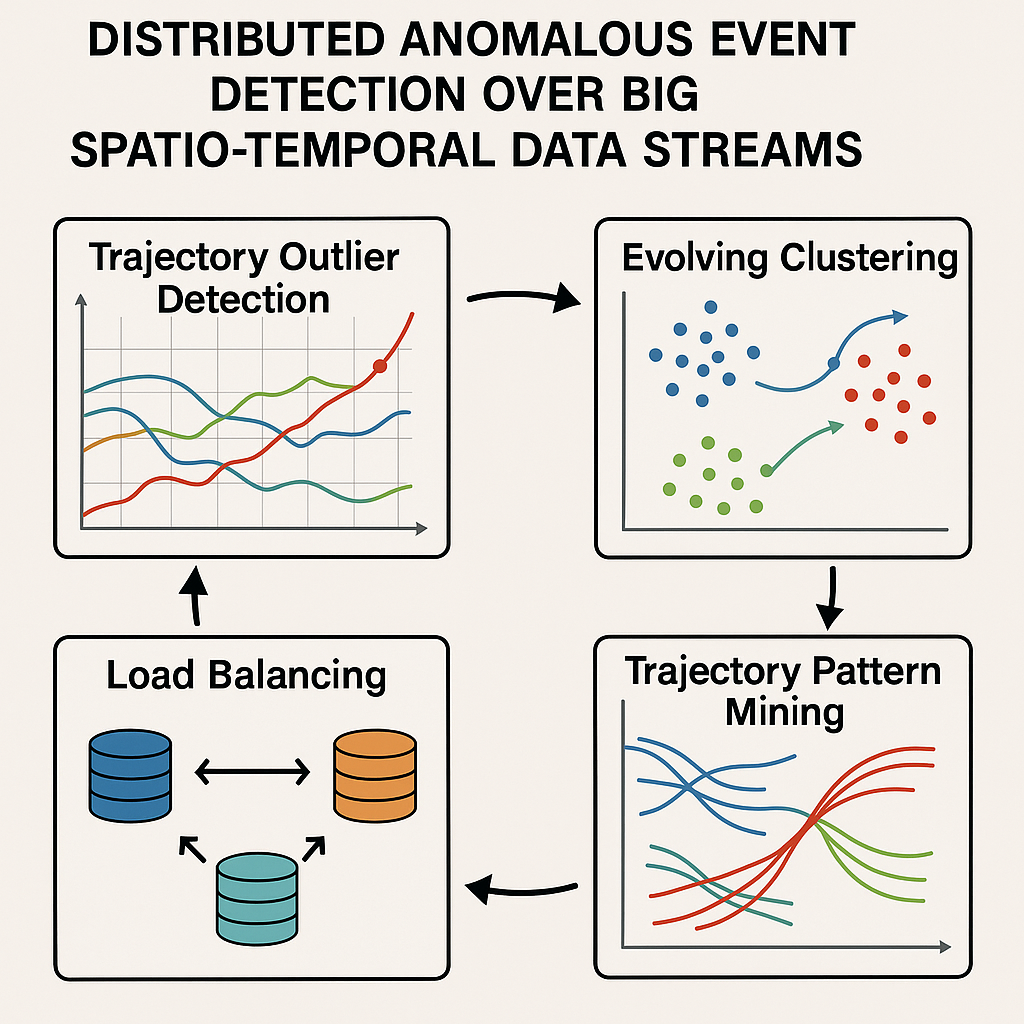 |